Evaluating the Geometric Hexagonal Coffee Cup Template for Paper Crafting
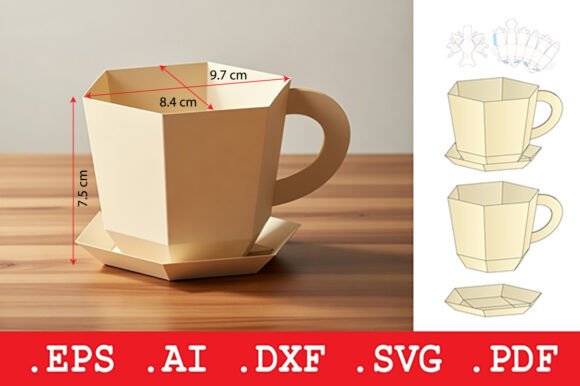
The Geometric Hexagonal Coffee Cup Template represents a specific niche within the broader category of digital papercraft designs. Unlike traditional cylindrical cup patterns, this template utilizes a six-sided polygonal structure to create a three-dimensional model of a coffee cup, complete with a matching saucer and a curved handle. For individuals interested in laser cutting, CNC routing, or manual paper assembly, understanding the utility and limitations of this specific geometric form is essential before downloading or purchasing the associated files.
This design shifts away from the organic curves of standard ceramic ware, offering a modern, faceted aesthetic. The template typically includes vector files such as .DXF for AutoCAD and CNC machines, .SVG for scalable web and cutting machine use, .EPS and .AI for professional graphic editing, and .PDF for immediate printing. Evaluating whether this template aligns with a specific project requires an analysis of its structural integrity, aesthetic application, and compatibility with available fabrication tools.
Understanding the Design Structure
At its core, the Geometric Hexagonal Coffee Cup Template is a flat-pack design intended to be folded into a volumetric shape. The hexagonal geometry provides distinct advantages over circular designs in terms of manufacturing and assembly. In paper crafting, creating a perfect cylinder often requires rolling techniques or complex curved scoring that can be difficult to execute consistently without specialized machinery. By contrast, the hexagonal form relies on straight fold lines and angular tabs, making it highly suitable for precision cutting methods like laser engraving or die-cutting.
The inclusion of a saucer and a curved handle adds complexity to the assembly process. The handle, while stylized to fit the geometric theme, must be engineered to support the visual weight of the cup without compromising the structural balance. When reviewing the provided file formats, users should note that the .DXF and .SVG files are critical for ensuring that cut lines and score lines are correctly interpreted by machinery. The .PDF version serves as a reliable reference for manual crafters who may not have access to vector editing software but wish to print and cut by hand.
Practical Applications and Use Cases
There are several scenarios where adopting the Geometric Hexagonal Coffee Cup Template offers a distinct advantage over standard packaging or decorative solutions. One primary application is in unique gift packaging. For boutique coffee roasters or tea shops, presenting a product in a hexagonal box shaped like a cup can enhance brand perception through novelty and tactile engagement. The geometric shape allows these packages to stack efficiently on shelves, utilizing space better than round containers which often leave gaps.
Another significant use case is in event planning, specifically for tea-party favors or wedding table settings. These paper cups can serve as holders for small treats, sugar cubes, or even as decorative place cards. The modern aesthetic appeals to contemporary design themes where minimalism and geometric patterns are prevalent. Furthermore, educators and workshop leaders may find this template valuable for teaching principles of geometry, spatial reasoning, and engineering. Assembling the cup requires an understanding of how two-dimensional nets translate into three-dimensional objects, providing a hands-on learning opportunity.
For interior designers or hobbyists, these templates can function as desk organizers or decorative accents. When crafted from heavier cardstock or thin wood veneer using the .DXF files, the resulting objects possess a durability that allows them to hold pens, brushes, or small office supplies, serving a functional role beyond mere decoration.
Benefits and Tradeoffs
When selecting a digital template, it is important to weigh the benefits against potential tradeoffs. A major benefit of the Geometric Hexagonal Coffee Cup Template is its versatility across different materials. The clean lines and defined angles make it ideal for laser cutting acrylic, wood, or thick cardstock. The vector formats (.AI, .EPS, .SVG) allow users to scale the design infinitely without loss of quality, enabling the creation of miniature models or oversized decorative pieces.
However, there are tradeoffs to consider regarding realism and functionality. Because the design is inherently geometric, it does not mimic the fluid contours of a real ceramic mug. For projects requiring a high degree of photorealism, a cylindrical template might be more appropriate. Additionally, the assembly of a hexagonal shape involves more seams and glue points than a simple cylinder. This can increase production time if the items are being assembled manually. Users must also consider the material thickness; if the material is too thick, the folding tabs may not align correctly, causing the lid or saucer to sit unevenly.
Another consideration is the handle attachment. In many geometric designs, the handle is a separate piece that must be glued or slotted into the main body. If the tolerance in the .DXF or .SVG files is not adjusted for the specific kerf of a laser cutter or the thickness of the paper, the handle may fit too loosely or be impossible to insert without forcing the material.
Decision-Making Insights for Selection
To determine if the Geometric Hexagonal Coffee Cup Template is the right choice for a project, creators should evaluate their end goals and production capabilities. If the objective is mass production using automated cutting machines, the straight edges of the hexagon offer speed and precision. The .DXF format is particularly strong here, as it is the industry standard for CNC and laser operations. Conversely, if the project involves children or beginners in a workshop setting, the .PDF version should be tested first to ensure the tab sizes are large enough for easy manipulation and gluing.
Users should also assess the intended lifespan of the final product. For single-use events like parties, standard cardstock printed from the .PDF is sufficient. However, for durable goods like desk organizers, the user must verify that the vector files allow for material compensation. This involves offsetting cut lines to account for material removal during laser cutting, a feature easily managed in .AI or .EPS editors but often fixed in pre-rendered .PDFs.
It is also worth considering the aesthetic context. The hexagonal shape conveys a sense of modernity and technical precision. If the surrounding decor or branding is rustic, organic, or traditional, this template might clash visually. In such cases, a template with softer curves or a different polygonal count (such as an octagon) might provide a better visual harmony. However, for tech-focused brands, modern cafes, or educational kits, the sharp angles of the hexagon reinforce the desired message.
Alternatives and Final Considerations
While the Geometric Hexagonal Coffee Cup Template offers a compelling blend of style and function, it is not the only option available. Alternatives include cylindrical templates, which offer a more classic look but can be harder to cut accurately without rotary tools, and other polyhedral shapes like cubes or tetrahedrons, which may be simpler to assemble but lack the recognizable "cup" silhouette.
Ultimately, the decision rests on the balance between aesthetic preference and manufacturing feasibility. The comprehensive file inclusion—ranging from .DXF for industrial use to .PDF for casual crafting—makes this template a robust resource for a wide audience. By carefully reviewing the file types against available equipment and considering the assembly requirements of the hexagonal form, users can effectively leverage this design to create distinctive, high-quality paper crafts that stand out in both form and function.